
Clients, engagements and deliverables, and an honest read on which one needs you this week.
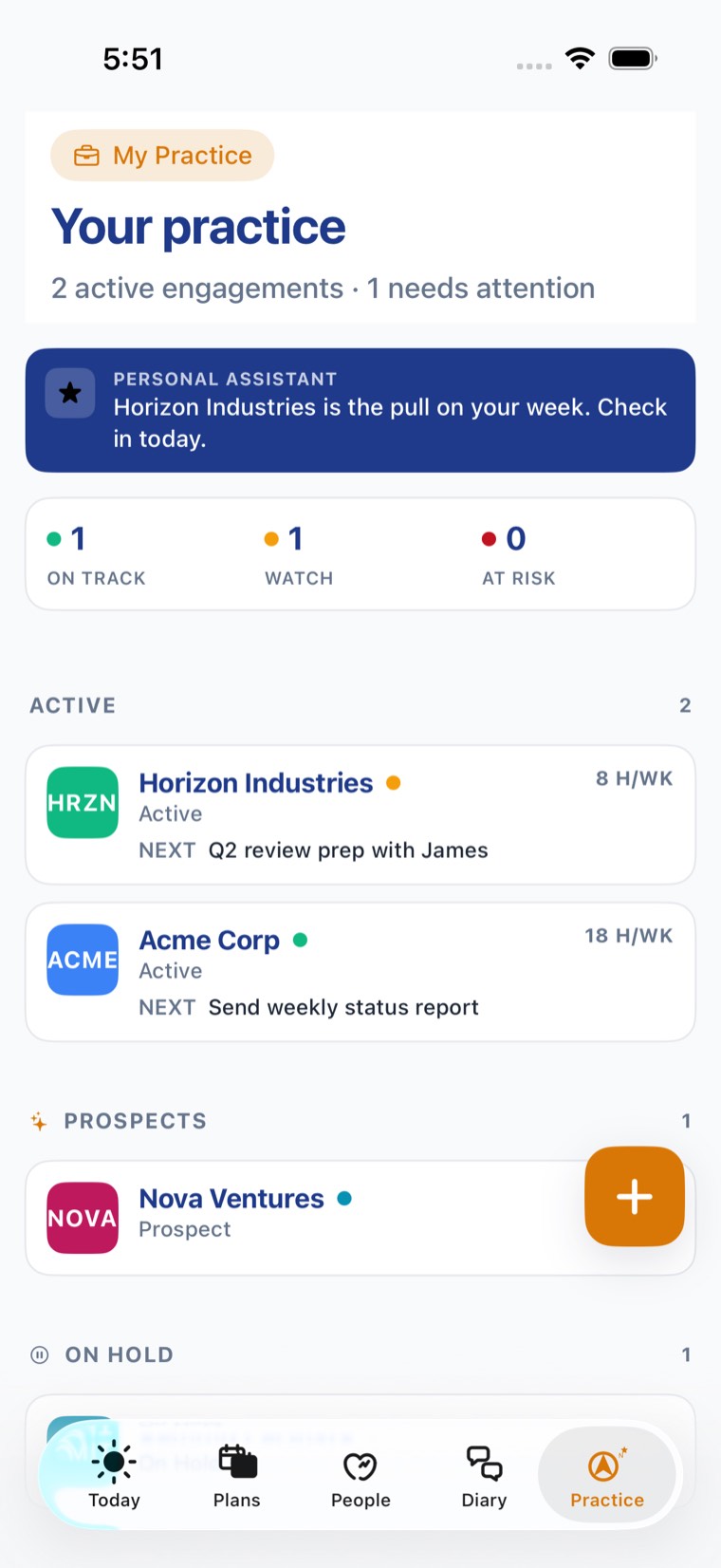
Tap the plus on the Practice tab and give the client a name. Add an engagement under it for the actual piece of work, with the hours a week you expect it to take.
That hours figure is doing real work. It is what lets the app tell you that three engagements at eighteen, eight and ten hours do not fit in your week, before the week proves it.
Clients you are still chasing go in as prospects, and work that has paused goes on hold. Both stay visible without counting against your capacity, which is the honest way to hold them.
Each engagement carries a short register: risks, assumptions, issues and dependencies. The point is not the taxonomy, it is having somewhere to put the thing you are worried about so it stops living in your head.
Every engagement shows one of three states. On track, watch, or at risk. The counts at the top of the screenshot above are these, and they are what turns a list of clients into a question you can answer in five seconds: is anything on fire.
An action raised against a risk becomes a task, so it appears in your day rather than only in the register you have to remember to open.
Once a week the app offers a review: what you finished, what slipped, what is due next, and which relationships have gone quiet.
It takes a few minutes and it is the difference between a system you maintain and one that quietly rots. Most of the value in everything above depends on somebody looking at it regularly, and this is the appointment where that happens.
You can change the day and time, or turn it off. It is a prompt, not an obligation.